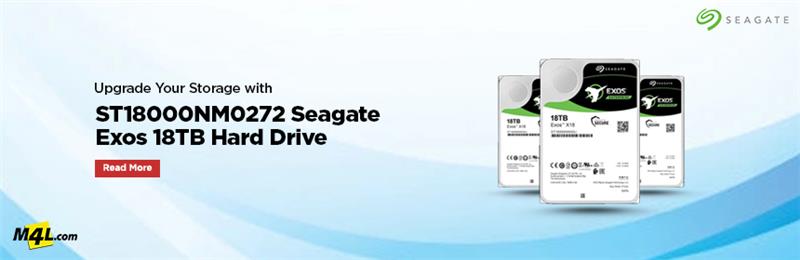
Upgrade Your Storage with ST18000NM0272 Seagate Exos 18TB Hard Drive
Introduction
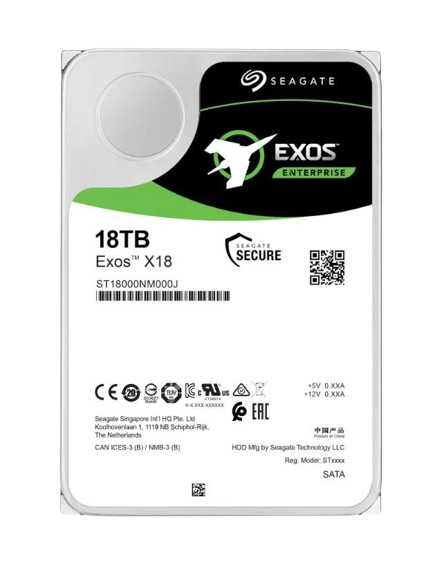
As organizations transition from petabyte-scale to exabyte-scale storage requirements, the physical limitations of traditional hard disk drives (HDDs) are being tested. The solution lies not in adding more spindles, which increases power consumption and rack space, but in increasing density per drive. The ST18000NM0272 Seagate Exos 18TB Hard Drive stands out as a powerful enterprise storage solution designed to handle massive workloads and mission-critical applications.
This technical blog explores the specifications, architecture, and performance benefits of the ST18000NM0272, detailing why it is the definitive choice for modern hyperscale infrastructures.
Key Features:
-
Enterprise-grade connectivity for high-speed data transfer and reliability.
- High-speed spindle and large buffer for consistent, responsive data access.
- Massive storage density optimized for hyperscale data centers and cloud environments.
- Delivers up to 2x the sequential and random performance of standard single-actuator drives.
Technical Specifications:
| Brand | Seagate |
| Part Number | ST18000NM0272 |
| Series | Exos 2X18 |
| Capacity | 18TB |
| Interface | SAS 12Gb/s |
| Form Factor | 3.5-inch internal |
| Spindle Speed | 7200 RPM |
| Buffer Size | 256MB |
| Disk Format | 512e/4Kn |
| MTBF | 2.5 million hours |
Massive Storage Capacity
With 18 terabytes of storage, organizations can store massive datasets, backups, multimedia content, and archival information without constantly expanding their hardware infrastructure. This high capacity is particularly beneficial for businesses managing large databases, virtualization environments, or media libraries. Instead of deploying multiple smaller drives, organizations can rely on fewer high-capacity drives to store the same amount of data. This approach not only reduces hardware costs but also simplifies system management and maintenance.
Advanced Helium Technology
The Seagate Exos 18TB drive utilizes advanced helium-sealed technology to enhance efficiency and performance. Helium is lighter than air, which reduces internal turbulence inside the drive. This allows the platters to spin more smoothly while consuming less power.
Reliability and Data Integrity
Despite the increased complexity of dual actuators, Seagate has not compromised on the ruggedness required for data centers. The drive features a helium sealed-drive design, which reduces turbulence and drag on the actuator arms, allowing for more precise head positioning while consuming less power.
Ideal Use Cases
Data Centers and Hyperscalers: With a 550TB/year workload rating, it's built for 24/7 operation. Deploy in HCI (hyper-converged infrastructure) like Nutanix or VMware vSAN for bulk storage tiers.
NAS and Home Labs: Pair with Synology DS1821+ or QNAP TVS-h1288X for massive archives. Its CMR tech excels in ZFS pools or BTRFS RAIDZ2, avoiding SMR-induced fragmentation.
Content Creation and Surveillance: Video editors benefit from sustained transfers for 8K editing timelines. NVR systems supporting 100+ cameras leverage its low latency for real-time writes.
Easy Integration with Existing Systems
Another advantage of the ST18000NM0272 hard drive is its compatibility with a wide range of enterprise systems. It can easily integrate with existing storage servers, RAID configurations, and data center infrastructure.
Preparing for the Future of Storage
As we move further into the era of big data and AI, the infrastructure must evolve. The Seagate Exos ST18000NM0272 represents a significant leap forward, proving that hard drives still have a vital role to play in the performance tier of the data center.
If you are looking to upgrade your storage infrastructure with trusted enterprise hardware, M4L offers high-quality hard drives tailored to business needs. Explore the Seagate Exos 18TB hard drive and other enterprise storage products through M4L today and take the next step toward building a faster, more efficient, and scalable storage environment for your organization.